

 English - EN
  繁體 - ZH-TW
  简体 - ZH-CN
  Español - ES
  日本語 - JA
  العربية - AR
  Русский - RU
  Français - FR
Choosing the Right Idler Roller Surface Coating: Anodizing, Hard Anodizing, Ceramic, Teflon and Chrome
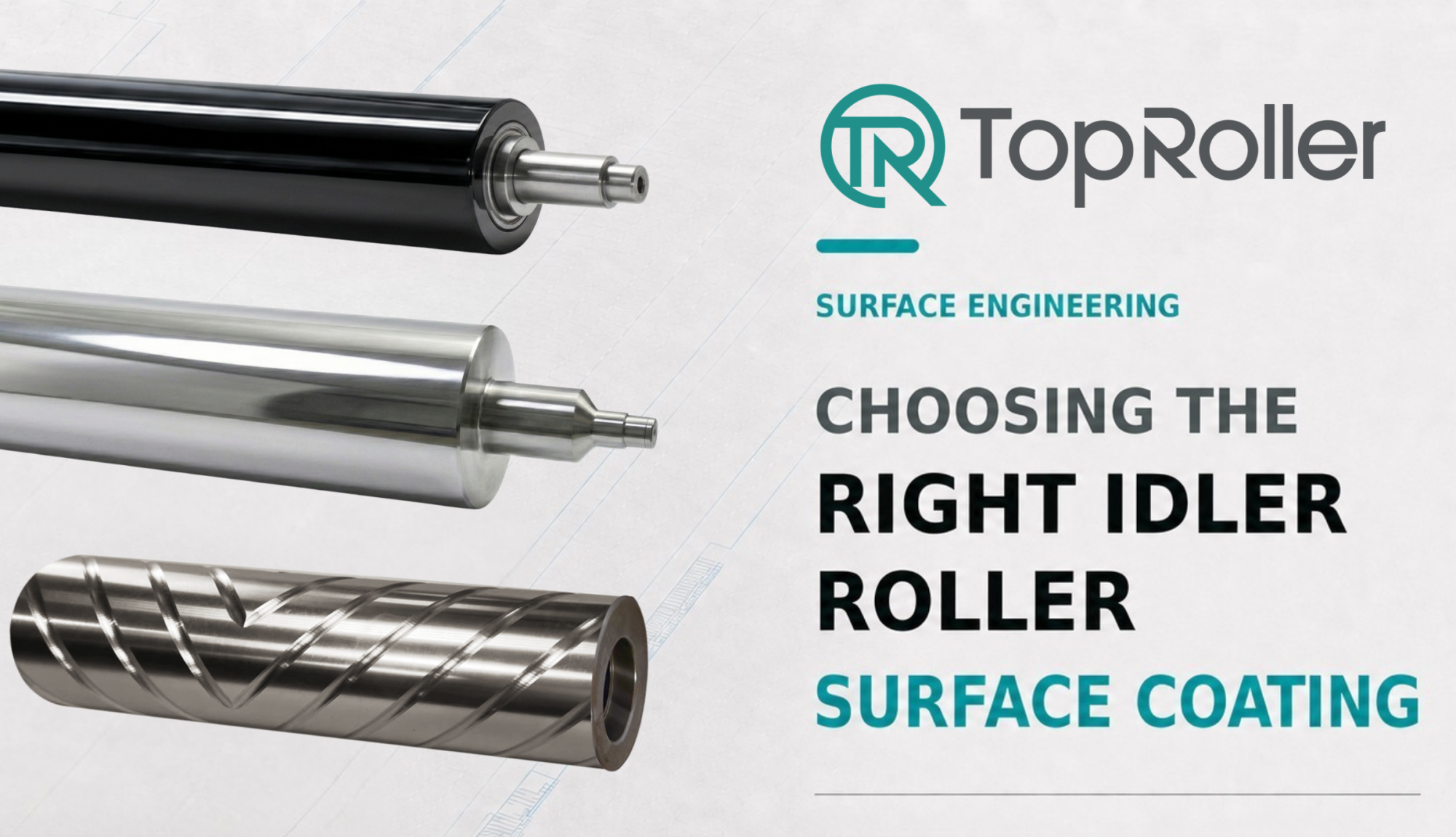
When engineers spec an idler roller, most of the attention goes to the tube material — aluminum or steel, wall thickness, diameter — but what really decides whether the line runs smoothly is often the surface treatment. The wrong finish shows up as slippage, adhesive build-up, scratched film, or premature corrosion; the right one lets the web run cleanly. Top-Roller offers eight surface treatments, each suited to a different processing need.
Hardness and Wear Resistance
For lines running under high tension or against abrasive substrates, the priority is a hard, durable surface. Anodizing grows a protective oxide layer on the aluminum itself while keeping the roller light. Hard anodizing uses a thicker, harder layer with better wear resistance than standard anodizing, and it offers good electrical insulation. Where wear is extreme, a ceramic layer is the highest-hardness, top-tier option and is likewise electrically insulating; hard chrome plating provides a hard, electrically conductive metal surface that can be polished to a finish of Ra 0.02–0.05.
Low Friction and Anti-Stick
When the web needs to glide with minimal drag, or when adhesives and solvents are involved, friction and release matter most. Teflon coating has a low coefficient of friction, together with non-stick, chemical-resistant, and heat-tolerant properties that keep adhesive residue and dirt from adhering to the roller surface. Chrome plating gives a smooth, fine surface that is easy to clean and low in friction, suited to lighter-duty guiding.
Grip and Surface Texture
Some rollers need to hold the web rather than let it slide. A rubber coating provides traction and cushioning for driving and pulling applications. Sandblasting creates a matte, textured surface that increases grip, helps release air trapped between the web and the roller, and reduces surface reflection.
Matching Coatings to Industry
Top-Roller's rollers run across a wide range of web-based industries, and the ideal coating shifts with each one. In plastic film and converting, anodizing and hard anodizing cover most needs, with Teflon for adhesive or high-temperature processes. In printing, anodizing resists basic oxidation and stays easy to clean. In food, corrosion-resistant finishes stand up to washdown and hygiene requirements. In paper and tissue, rubber and textured surfaces provide the traction and air release that high-speed lines need. In textile and non-woven, low-friction finishes guide the web without snagging fibers. In semiconductor and AOI applications, hard anodizing reduces reflection during automated optical inspection, while a finely polished roller surface protects delicate films from scratches.
Technical Evaluation
The ideal roller specification and surface treatment ultimately depend on the material and the real process conditions the customer works with. Drawing on extensive machining experience, Top-Roller's team can review and evaluate the job once the customer provides a drawing and basic requirements, offering professional advice on tube machining, wall thickness, and surface treatment.
Beyond making new rollers, Top-Roller also offers a roller repair and refurbishment service to extend the life of existing equipment.

شريك التعاونية